THE BRITISH OVERSEAS RAILWAYS HISTORICAL TRUST
|  |
Modelling British Overseas Railways
This article was written by Julian Rainbow with minor edits by Glyn Thomas.
For the purposes of this article, "British Overseas Railways" includes railways built, operated, supplied or heavily influenced by British interests throughout the former Empire, Dominions, Colonies, Protectorates and spheres of commercial influence. The modelling opportunities range from major systems such as India, South Africa and Australia to military railways and small colonial lines.
Although British overseas railways have never attracted the following enjoyed by British, North American or German prototypes, there has never been a better time to model them. Modern manufacturing techniques, internet research resources and specialist suppliers have made even the most obscure colonial or military railway increasingly accessible. The principal obstacle is no longer the lack of information but deciding which railway to model.
The late Paul Waters suggested to me some years ago that I should write about the modelling of overseas railways. I do this with some trepidation, as I collect overseas railway models rather than at least run them or even model them, and the least said about the Council’s attempt to lay track on the baseboard on my dining room table the better. It has not extended for more than 25 plus years. This article will hopefully stimulate some debate.
Choosing a Prototype
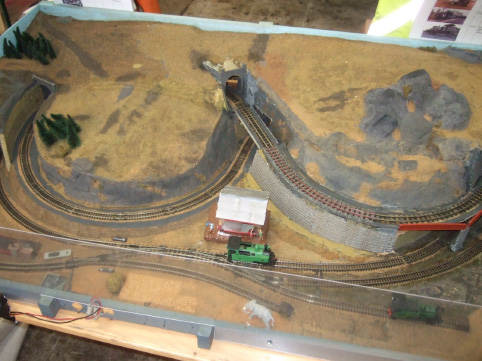
How one goes about modelling overseas railways, I think, depends on whether you want to model a specific country or do you, like me, want to have somewhere to run your collection of various British overseas models. I would quite happily have a railway set on a mythical Indian Ocean island, so I can run a whole variety of locomotives and rolling stock from numerous railways, without having to worry that I had the correct signals etc. Manning the BORHT Outreach Stand we noted at shows that you need to have something moving to attract most people’s attention. A prototype was unnecessary for us as we wished to demonstrate the range of British export material. Many people are happy to watch trains run round a circuit of track, I think this is especially true if they bring young children to a show. Probably, our most successful layout in keeping the public, especially children amused was our 009 figure of 8 circuit on two levels. A train would disappear into a tunnel, and the children would get great enjoyment from deciding where it would exit the tunnel.
What Era?
It seems that people prefer an era that they are familiar with. Many of the people who chased the remnants of British steam around the world became modellers and gravitated to representing the steam era from the 1950’s onwards. This has largely been superseded by modellers of the diesel and electric eras. There is also increasing interest in earlier steam eras due to smaller trains, stylish locomotives and colourful liveries. There are few models available of what is called Epoch I. I can only think of two HO models of the first European Railways one is a model of Der Adler by Trix for Germany and the other Der Ahrend for Holland.
| Epoch I | 1848–1920 |
| Epoch II | 1921–1948 |
| Epoch III | 1949–1970 |
| Epoch IV | 1971–1990 |
| Epoch V | 1991–2005 |
| Epoch VI | 2006–Current |
Scale and Gauge
This brings us to the question of scale and the closely related question of gauge. For the narrow gauges the British standard is 4mm (1:76) to the foot with OO9 track (9mm gauge like N-gauge but with OO-scale details), and this is fine provided you only want to model a narrow-gauge prototype, such as the Cyprus Government Railway or the Sierra Leone Government Railway. Many overseas railways modellers work in HO (1:87), especially if they are modelling the mainline systems of the chosen country, with the exception of New Zealand. HO is 3.5mm to the foot and the discrepancy is most noticeable.
| Prototype Gauge | HO Equivalent |
| Standard Gauge | 16.5 mm |
| Cape Gauge | 12 mm (HOm/HOn3½) or 16.5 mm compromise |
| Metre Gauge | 12 mm (HOm) |
| 5 ft 3 in | ~18.4 mm |
| 5 ft 6 in | ~19.3 mm |
The problems arise if you want to have a narrow-gauge interchange with a wider gauge line for instance, Rhodesia Railways/Selukwe Peak Light Railway interchange where you would have Rhodesia Railways at 3.5mm and the Selukwe Peak at 4mm. I can only think of a few British outline models in OO scale that can be used to model any of our export locomotives. Bachmann did a Kowloon-Canton Railway 2-8-0 some years ago, there are various models of the English Electric 0-6-0 shunter and Gem did a Dean Goods many years ago with Oxford Diecast and Hornby producing versions more recently. DJH Model Loco of Consett produced white metal kits of both the 2-8-0 and 2-10-0 Austerities in both HO and OO. Bachmann, Clarks Railworks and Accurascale have recently produced OO scale models of all 3 Austerities. But these are effectively limiting you to modelling a British military overseas railway as I cannot think of any Continental models in OO to accompany them.
This effectively means that anyone wanting to model a main line overseas railway has to use HO scale unless you consider N Gauge. This also brings in the problems of track gauge. Are you content to accept 16.5 mm track and the resulting inaccuracies if your prototype is Cape Gauge or Broad Gauge, or will you wish to use 12 mm for metre and Cape Gauges or build your own track for the broad gauges to either 18.38mm for 5’ 3” or 19.25mm for 5’ 6” track even if that may restrict your choice of motive power. Certainly, commercial models of Spanish and Portuguese railways use 16.5mm track. I believe that part of this problem arose in the early days of commercial model availability when the big manufacturers looked at what was likely to be a very small market and decided that producing 12mm gauge track and rolling stock was not worth the effort.
Tillig produce dual gauge track in both HO/HOm and HO/HOe. We had the upgraded BORHT circuit at the Chatham Show in 2026 and having a circuit of each gauge enabled us to run models of various prototypes easily and it did also enable us to engage with the railway modeller visitor who noticed the track and were intrigued by it.
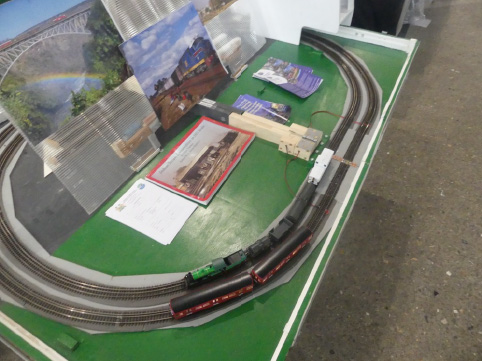
I touched on N-gauge, and it has points in its favour. We are looking a very long prototype trains and using N-gauge does allow you make a better representation of those trains in the limited amount of space in many British houses. I find it too small myself, and from what I see in researching the area there is a limited variety of rolling stock.
I have not even considered the many other narrow-gauge possibilities.
Space Available
There is also the question of how much space you have, overseas railways tend to have longer trains than we do in the UK and the locomotive power and rolling stock are larger, even if the gauge is smaller. So, in some ways it is a choice if you want to have an exhibition layout or a home layout. There are different aspects to consider in these cases.
I think that some of the problem in modelling mainline British overseas railways is that you will need large radius curves to permit use of the larger locomotives that are typical overseas. We are looking at a minimum radius of 30” and preferably larger. If we start using kit-built locos large radius curves are mandatory, they do not have the flexibility that commercial RTR models have inbuilt.
If you do decide to build an exhibition layout what is its purpose? Enable you to show off your modelling skills, encourage others to take up the hobby, show others what railways look like in different countries or in past times?
Not least if you build an exhibition layout is how to safely transport your rolling stock from home to the exhibition. Personally, I have started using the Trainsporter boxes. I find them easy to carry and they can hold a good quantity of rolling stock. They do relieve you of taking models out of their manufacturers display boxes and more importantly getting them back in at the end of s show. I still retain the manufacturers boxes for storage.
What I am NOT Talking About
I will not be talking about constructed baseboards, laying track, electrics etc., as that is well outside my competence.
|
| Registered Charity No 290944 | Company Limited by Guarantee No 1862659 |